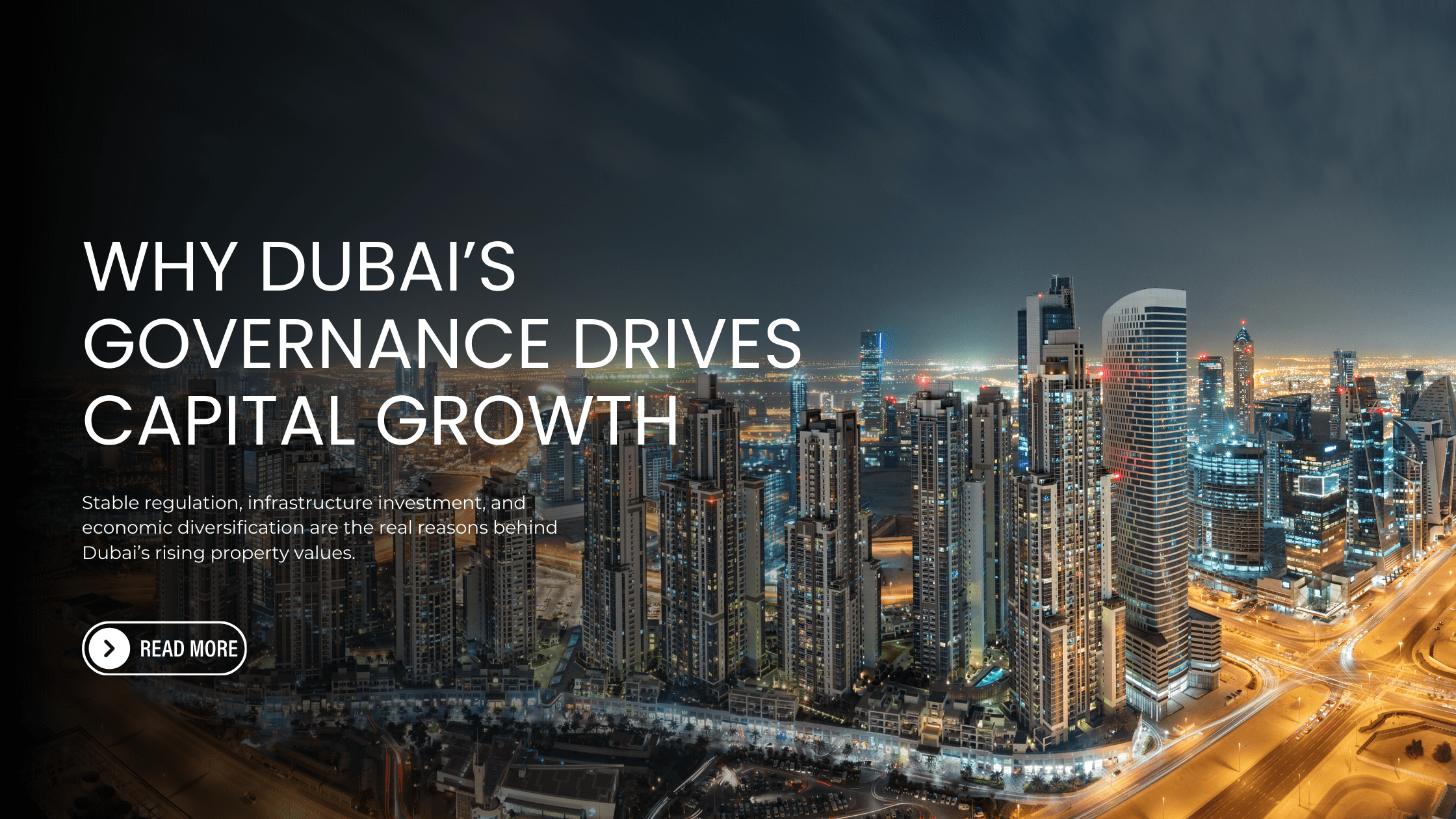
When investors evaluate capital appreciation in Dubai, they usually focus on supply and demand, infrastructure, and location quality. However, one factor consistently determines whether prices rise sustainably over time. That factor is good governance. Clear regulations, long-term planning, investor protection, and a strong economic vision create confidence. Capital flows toward stability, making effective governance the single biggest catalyst for long-term capital appreciation in Dubai.
Let us break down how this works, using Dubai as the strongest example.
Policy Stability Builds Investor Confidence and Capital Appreciation
Real estate capital appreciation depends heavily on predictability. When governments maintain consistent property laws, avoid sudden taxation changes, and protect foreign ownership rights, investors are more willing to commit long-term capital.
Dubai provides:
- Transparent ownership laws
- Strong legal frameworks
- Long-term residency options (such as the Golden Visa)
- Pro-business policies
Regulatory bodies such as the Dubai Land Department (DLD) ensure structured oversight of transactions and developer compliance. When investors feel secure, they hold assets longer. Reduced panic selling supports price stability, which ultimately safeguards steady capital appreciation in Dubai.
Master Planning and Developer Regulation Prevent Oversupply
Poor governance often leads to uncontrolled development. Excess supply damages capital growth. Dubai follows structured urban planning through authorities such as the Dubai Municipality. Development is phased, and infrastructure is strictly aligned with community expansion.
This includes:
- Zoning controls
- Infrastructure coordination
- Strict developer regulations
- Controlled project approvals
By ensuring a healthy equilibrium between supply and demand, governance initiatives successfully protect property values. This structured approach is essential for investors seeking predictable capital appreciation in Dubai‘s competitive market. If you are looking into specific asset types, you can see how this supply management keeps demand high for a townhouse for sale in Dubai.
Infrastructure Investment Multiplies Property Value
Governments that invest aggressively in public infrastructure create long-term value for surrounding communities. Dubai’s strategic, multi-billion-dollar projects include:
- Expo City Dubai
- Al Maktoum International Airport
- The expansion of the Dubai Metro
Improved connectivity increases tenant demand, and increased demand strengthens property prices. Accessibility directly impacts asset value, acting as a direct engine for capital appreciation in Dubai‘s emerging residential and commercial hubs.
Economic Diversification Protects the Real Estate Market
Cities dependent on a single economic sector are highly vulnerable to downturns. In contrast, diversified economies protect property capital growth. Dubai’s governance model actively supports multiple thriving industries:
- Tourism and hospitality
- Logistics and trade
- Financial services (DIFC)
- Technology and innovation
- Real estate and construction
This diversification creates employment stability and continuous population growth, which directly increases housing demand. Established areas such as Downtown Dubai, Dubai Marina, and Business Bay benefit from multiple economic drivers rather than a single source of demand, securing a higher baseline for property yields. For a deeper look into maximizing your earnings from these factors, read our comprehensive guide on high ROI property in Dubai.
Regulatory Transparency Attracts Global Capital
International investors prioritize markets with clear rules and strict law enforcement. To foster a world-class investment ecosystem, Dubai introduced:
- Escrow account laws to protect off-plan buyers
- Strict developer compliance regulations
- Transparent transaction tracking via open data
- Strong dispute resolution systems (Rental Dispute Center)
These legal systems reduce overall investment risk and encourage large-scale institutional investment. Global capital flows toward markets where governance is structured and reliable, accelerating capital appreciation in Dubai across premium residential sectors.
Long-Term Vision Drives Sustainable Growth
Short-term political cycles often disrupt property markets in many international cities. Dubai operates under long-term strategic frameworks, most notably the Dubai 2040 Urban Master Plan.
This master plan creates defined growth corridors, environmental standards, and infrastructure roadmaps. Investors can identify emerging areas with greater confidence, such as eco-conscious developments. You can explore how sustainable governance affects community planning in our guide to green communities in Dubai. Ultimately, a unified long-term vision supports long-term capital appreciation.
Why Capital Appreciation in Dubai Stands Out Globally
Dubai combines:
- Investor-friendly regulation
- Continuous infrastructure expansion
- Macroeconomic diversification
- Regulatory transparency
- Strategic urban planning
The result is a real estate market that demonstrates unique resilience during global downturns and exceptional recovery performance. Capital appreciation in Dubai is not accidental; it is structurally engineered by proactive governance.
Final Insight
Capital growth is not driven by speculation alone. It is built on governance quality. Stable regulation, strategic planning, infrastructure foresight, and investor protection create the foundation for sustainable real estate returns.
Dubai shows that when governance is strong, property markets become predictable, resilient, and highly attractive to global capital. The real question for investors is not only whether a location is growing today, but whether it is governed well enough to sustain that growth tomorrow.